

Hand Injury Legal Information
Hand and wrist injuries occur across Hand and wrist injuries happen across Queensland every day – and can extend well beyond the initial event. Medical appointments, time away from work, and uncertainty about what the law provides are all common experiences for people in this situation.
Queensland law sets out distinct legal frameworks that may apply after a hand injury, depending on how and where it occurred. Understanding which framework applies to your circumstances is a useful first step.

 80 Reviews
Common Hand and Wrist Injuries
Hand and wrist injuries vary widely in their nature and severity. Some resolve with short-term treatment, while others result in lasting effects on hand function, grip or sensation. Common hand and wrist injuries that may be relevant in a legal matter include:
- Fractures to the fingers, hand, wrist or forearm, including broken hand injuries from impact or falls
- Crush injuries from entrapment between objects or machinery
- Tendon and ligament damage from trauma or overuse
- Nerve injuries, including carpal tunnel syndrome arising from repetitive hand movements
- Burns, cuts and lacerations
- Repetitive strain injuries affecting the hand and fingers
- Hand-Arm Vibration Syndrome from prolonged use of vibrating tools
- Amputations or partial loss of fingers
- Complex Regional Pain Syndrome affecting hand and arm function

Work-Related Hand Injuries
Workers involved in manual tasks, machinery operation or sustained repetitive hand movements face a higher risk of serious injury. Queensland’s workers’ compensation law sets out rules and regulations governing entitlements for work-related hand injuries based on the nature and circumstances of the injury.
Injuries in the workplace can arise from a single incident, such as a crush injury or broken hand, or they can develop gradually through repetitive tasks. A work injury involving the hand or fingers may affect a worker’s ability to perform their regular duties or, in serious cases, their capacity to work more broadly.
Certain roles and industries carry a higher risk of work-related hand injuries. Hand and finger injuries commonly arise in:
- Machinery operation and manufacturing
- Construction work, including carpentry, plumbing and electrical trades
- Warehouse and logistics work
- Hospitality and food preparation
- Healthcare and patient handling
- Office-based roles involving repetitive hand movements
- Cleaning or chemical handling
Keeping thorough records after a work injury supports the legal procedure. Documents that may be relevant in a workers’ compensation matter include:
- Incident reports lodged with an employer or supervisor
- Medical certificates and diagnostic imaging
- Treatment records and invoices
- Rosters or wage records
- Photographs of equipment, surfaces or hazards
- Witness names and contact details
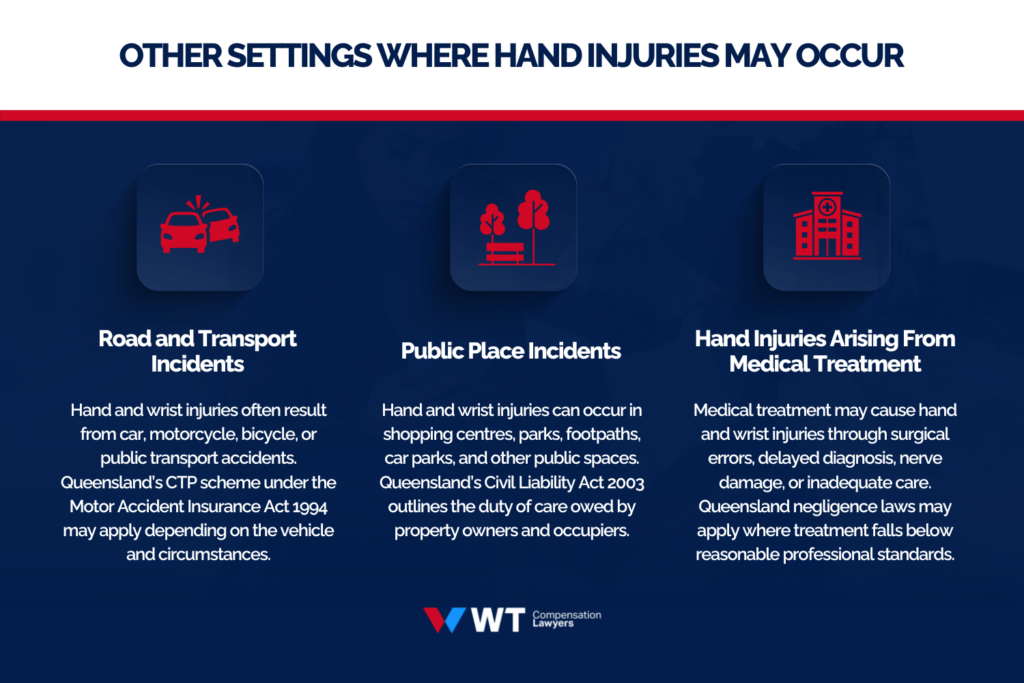
Other Settings Where Hand Injuries May Occur
Hand and wrist injuries aren’t limited to the workplace. Road incidents, falls in public spaces and issues arising from medical treatment can each result in serious hand or wrist injuries. The applicable legal framework depends on the setting and the circumstances of the injury.
Hand and wrist injuries are frequently sustained in vehicle incidents, including car, motorcycle and bicycle accidents. Injuries may also occur on public transport such as buses, trains, ferries or trams. The Motor Accident Insurance Act 1994 governs the Compulsory Third Party (CTP) scheme that applies in Queensland for motor vehicle incidents. The applicable framework depends on the type of vehicle involved and the circumstances of the incident.
Hand and wrist injuries can occur in public spaces, including shopping centres, footpaths, car parks, parks and privately managed premises. Queensland’s Civil Liability Act 2003 sets out the duty of care that property owners, occupiers and managers owe to people using those spaces. Where that duty wasn’t met, negligence law may be relevant to the legal assessment of the matter.
Hand and wrist injuries can arise in a medical setting, including from surgical procedures on the hand, wrist or forearm, post-operative complications, misdiagnosis of fractures or nerve damage, and delayed or inadequate treatment of a known injury.
Queensland’s law of negligence, as set out under the Civil Liability Act 2003, applies to medical practitioners and health services in the same way it applies to other parties. Where treatment fell below the standard reasonably expected, a separate legal pathway may exist.
How do Legal Frameworks Differ for Hand Injuries?
The legal framework that applies to a hand injury depends on the facts of the matter – including where the injury occurred, who was involved and which law governs that setting. Several distinct frameworks may be relevant depending on the circumstances.
| Legal Framework | Setting | Key Law | Time Limit (General) |
|---|---|---|---|
| Workers’ Compensation | Workplace | Workers’ Compensation and Rehabilitation Act 2003 | 6 months from incident |
| Motor Accident (CTP) | Road / Transport | Motor Accident Insurance Act 1994 | 9 months notice requirement |
| Public Liability | Public / Private Premises | Civil Liability Act 2003 | 3 years (general) |
| Medical Negligence | Healthcare Setting | Civil Liability Act 2003 | 3 years (general) |
Workplace Injury Schemes
Queensland’s workers’ compensation law, under the Workers’ Compensation and Rehabilitation Act 2003, provides a structured framework for people who suffer a hand injury at work. It covers medical expenses and rehabilitation and, in some circumstances, lost income where a worker is unable to work during recovery. The applicable scheme and its rules depend on employment type and how the injury occurred.
Negligence Law
Where a hand injury resulted from another party’s failure to take reasonable care, negligence law may apply. A negligence matter considers whether a duty of care existed, whether a breach occurred, whether that breach caused the injury and what losses followed as a result.
Hand and wrist injuries caused by unsafe workplaces, poorly maintained public spaces, or road incidents can each raise negligence considerations. We’re experienced in assessing which framework applies and explaining your options clearly.
Insurance Law
Insurance arrangements are relevant in many hand injury matters across Queensland. Motor vehicle incidents typically involve a Compulsory Third Party (CTP) insurer, governed by the Motor Accident Insurance Act 1994. Public liability matters may involve a property owner’s insurer. The applicable insurer depends on how and where the injury occurred.
 FREE CLAIMS CHECK TAKES 2 MINUTES
 What to do After a Hand Injury
After a hand injury, there are some practical steps worth being aware of. These aren’t legal requirements in all circumstances, but they may be relevant to how your matter is assessed depending on which framework applies.
In a workplace setting, it’s worth reporting the injury to your employer or supervisor as soon as reasonably practicable and keeping a copy of any incident report lodged. For a road or transport incident, a police report may be required. An injury in a public place should be reported to the venue or property manager where possible.
Maintaining a record of medical treatment from the date of the injury can be helpful. Relevant documents include medical notes, diagnostic imaging, invoices and photographs of the injury. Employment records, rosters and payslips may also be relevant where the injury affects work capacity.
Time limits vary depending on the legal framework and how the injury occurred. Key timeframes include:
- Workers’ compensation: a work injury must generally be reported to an employer as soon as practicable, with a formal matter lodged within six months of the incident
- Motor accident matters: notice requirements can apply within nine months of the incident under Queensland’s CTP scheme
- Negligence matters: proceedings must generally commence within three years of the date of the injury, though shorter notice periods may apply in some circumstances
- Gradually developed injuries: timeframes may run from the date of diagnosis rather than the date of the incident
Missing a reporting deadline can affect whether a matter can proceed. Timeframes vary by scheme and injury type, and exceptions apply in some circumstances.
What Factors are Relevant to a Hand Injury Matter?
Several factors influence how a hand injury matter is assessed under Queensland law. Each matter turns on its own facts, the applicable legal framework and the evidence available. Relevant considerations include:
- The nature and severity of the injury, including whether fractures, crush injuries or tendon damage are involved
- Whether the injury affects hand function, grip strength, sensation or dexterity
- The injury’s effect on work capacity and the ability to perform regular tasks
- Whether any restrictions on work are likely to be temporary or longer-term
- Treatment needs, rehabilitation requirements and ongoing medical management
- Whether symptoms are temporary or likely to be permanent
- The strength and completeness of the evidence available
- The applicable Queensland legal framework based on how and where the injury occurred
Have questions about a hand injury matter? Get in touch with WT Compensation Lawyers. We offer free initial consultations and our team will explain your situation clearly. Call 07 3924 9544 or visit wtlaw.com.au.
 FREE CLAIMS CHECK TAKES 2 MINUTES
 Hand Injury Legal Information FAQs
The same legal frameworks apply to hand and wrist injuries as to other injury types. The nature and location of the injury affects the medical evidence required and what losses may be relevant to the assessment of the matter.
Queensland’s workers’ compensation law doesn’t apply a fixed scale. Each matter is assessed individually against the applicable scheme’s rules, the severity of the injury and its effect on the worker’s capacity to work. We’re happy to explain how the assessment procedure works in plain language.
Yes, it can. A workplace hand injury may involve both workers’ compensation law and a negligence claim. A transport-related hand injury may raise both motor accident and public liability considerations. The applicable frameworks depend on the specific circumstances of each matter.
A pre-existing condition doesn’t automatically prevent a matter from proceeding. The relevant question is whether the incident aggravated or worsened the existing condition. This is a factual question that’s assessed on the evidence available in each case.
Witness evidence is one form of evidence, not the only form. Incident reports, medical records, diagnostic imaging and employer documentation can each be relevant in supporting a legal matter. We’d encourage you to gather and keep any documentation you have.
Time limits may run from the date of diagnosis rather than the date of the incident in some circumstances. This depends on the applicable legal framework and the nature of the injury. Delays can affect the legal position, so it’s worth understanding the relevant timeframes early.
Back to Top: Hand Injury Legal Information
Meet Our Car Accident Lawyers

Jonathan Wu
Managing Director
Jono leads WT Law with a client-first focus, managing Queensland operations and ensuring positive outcomes.

Sinaumea Taufao
Director
Sinau began at top-tier international firm Minter Ellison, then specialised in personal injury law, driven to fight for underdogs and serve Pacific Island and broader communities.