

Ankle Injury Legal Information
Ankle injuries happen across Queensland every day – in workplaces, on public roads, in shopping centres and in public spaces. As a result, medical appointments, and/or time away from work are unavoidable, and questions about which laws apply are all common for people in this situation.
Queensland law sets out distinct legal frameworks that may apply after an ankle injury, depending on how and where it occurred. This page outlines those frameworks in plain language. If you’d like to discuss your circumstances, we’re available for a free initial consultation.

 80 Reviews
Common Causes of Ankle Injuries
Ankle injuries arise across a wide range of circumstances, and understanding how an injury occurred is relevant to identifying which legal framework may apply. The sections below outline the most common settings in which ankle injuries occur across Queensland.
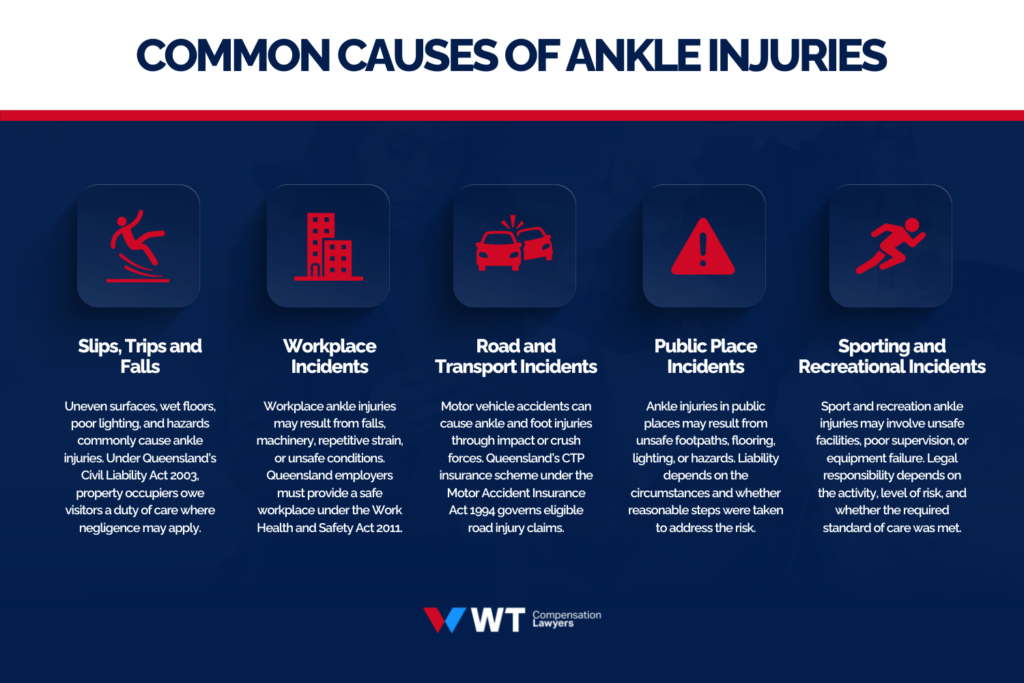
Slips, Trips and Falls
Uneven surfaces, wet floors, poor lighting, and unmarked hazards are common contributors to ankle injuries from slips, trips, and falls. These incidents occur in workplaces, public spaces, retail and on private property. Under the Civil Liability Act 2003 (Qld), an occupier owes a duty of care to people who enter their premises. Where that duty isn’t met and an ankle injury results, negligence law may be relevant to the assessment of the matter.
Workplace Incidents
Work-related ankle injuries can result from falls from height, contact with moving equipment, unguarded machinery, or repetitive strain. Workers in construction, warehousing, transport, and retail face a higher risk of ankle injuries due to the physical nature of their roles. Under the Work Health and Safety Act 2011 (Qld), employers are required to provide a safe working environment. Where that obligation isn’t met and an ankle injury at work occurs, WorkCover Queensland and work injury provisions under Queensland law may be relevant.
Road and Transport Incidents
Motor vehicle collisions frequently result in ankle and foot injuries from impact, crush forces, or sudden braking. Motorcyclists, cyclists and pedestrians are particularly exposed in these incidents due to reduced physical protection. Queensland’s Compulsory Third Party (CTP) insurance scheme, administered under the Motor Accident Insurance Act 1994, governs injuries sustained in road incidents in Queensland.
Public Place Incidents
Ankle injuries in public places can occur due to poorly maintained footpaths, unmarked hazards, unsafe flooring, or inadequate lighting. Local councils, business owners, and property managers each carry a distinct duty of care obligations under the Civil Liability Act 2003 (Qld). Whether a legal framework applies depends on the nature of the hazard, the steps taken to address it and the circumstances of the incident.
Sporting and Recreational Incidents
Ankle injuries sustained during sport or recreation can result from inadequate supervision, poorly maintained facilities, or equipment failure. Organised sporting bodies, event organisers and facility operators may carry a duty of care obligation depending on the nature of the activity and the level of risk involved. Whether a legal framework applies turns on the specific circumstances and whether the applicable standard of care was met.
Types of Ankle Injuries
The ankle joint is a complex structure involving bones, tendons, ligaments and soft tissues. Damage to any of these components can produce varying degrees of pain, instability and long-term effects on mobility. Types of ankle injuries seen in legal matters across Queensland include:
Stretching or tearing of the ligaments that support the ankle joint, ranging from mild to more serious.
A break to one or more bones in the ankle, sometimes requiring surgery and prolonged immobilisation.
Where the bones of the ankle are forced out of normal alignment, often accompanied by ligament damage.
Including Achilles tendon ruptures, tendonitis and ligament injuries that can cause lasting instability.
Where the ankle is trapped or compressed, potentially producing long-term complications.
- Some ankle injuries lead to chronic pain, post-traumatic arthritis or a permanent reduction in mobility.
Legal Frameworks That May Apply After an Ankle Injury
Queensland law sets out distinct frameworks depending on how and where an ankle injury occurred. The table below summarises the main frameworks, the settings they apply to, the relevant legislation, and the general timeframes involved.
| Legal Framework | Setting | Key Law | Time Limit (General) |
|---|---|---|---|
| Workers’ Compensation | Workplace | Workers’ Compensation and Rehabilitation Act 2003 | 6 months from incident |
| Motor Accident (CTP) | Road / Transport | Motor Accident Insurance Act 1994 | 9 months notice requirement |
| Public Liability | Public / Private Premises | Civil Liability Act 2003 | 3 years (general) |
| Sporting / Recreational | Organised Sport / Facilities | Civil Liability Act 2003 | 3 years (general) |
Ankle Injuries at Work
Workers who suffer an ankle injury at work may have access to WorkCover Queensland, a statutory scheme that addresses workplace injury matters, including medical treatment and income-related impacts. Where employer negligence contributed to the injury, work injury provisions under Queensland law may also be relevant. We’re experienced in identifying which provisions apply and can explain the distinction clearly.
For more information about workers’ compensation entitlements in Queensland, visit our personal injuries page.
Ankle Injuries in Public Places
Where an ankle injury occurs on someone else’s property due to an unsafe condition, the Civil Liability Act 2003 (Qld) may be relevant. Whether a legal framework applies depends on the duty of care owed, whether that duty was breached, and whether the breach caused the injury.
Ankle Injuries in Road or Transport Incidents
Ankle injuries sustained in a motor vehicle incident in Queensland are generally governed by the CTP scheme. For further information on how motor vehicle incidents are handled, visit our car accident lawyers page.
 FREE CLAIMS CHECK TAKES 2 MINUTES
 Records and Time Limits
After an ankle injury, keeping thorough records and being aware of the relevant timeframes can be important. The specific obligations and deadlines differ depending on which legal framework applies.
Documents that may be relevant in an ankle injury matter include:
- Medical records and treatment history documenting the injury and its progression
- Photographs of the location where the injury occurred
- Witness contact details
- Incident or accident reports lodged at the time of the injury
- Records of expenses or lost income connected to the injury
Time limits apply to legal matters involving ankle injuries in Queensland and vary depending on the applicable framework. Key timeframes include:
- Workers’ compensation: an injured worker generally has six months from the date of the injury to lodge a notification with WorkCover Queensland
- Motor accident matters: notice requirements can apply within nine months of the incident under Queensland’s CTP scheme
- Public liability and common law matters: a three-year limitation period generally applies from the date of the injury
- Children and delayed diagnosis: different rules may apply in some circumstances
Missing a reporting deadline can affect whether a matter can proceed. It’s worth understanding which timeframes apply to your circumstances as early as possible.
How Ankle Injury Legal Matters Are Assessed
Several factors inform how a legal matter involving an ankle injury is assessed under Queensland law. Each matter turns on its own facts and the legal framework that applies to the circumstances in which the injury occurred. Relevant considerations include:
- The severity of the injury and its effect on daily life and the ability to work
- Any ongoing symptoms or permanent effects on long-term function and mobility
- Medical evidence covering diagnosis, treatment history, and prognosis
- Expert opinion where the long-term effects of the injury are complex or disputed
- Documented financial loss, including lost income and out-of-pocket expenses connected to the injury
- The strength and completeness of the records available
Understanding Which Legal Framework Applies
Identifying the correct legal framework early is relevant to how a matter proceeds. The framework that applies depends on the circumstances of the injury – where it occurred, who was involved, and what laws govern that setting.
We work with people across Queensland who’ve suffered ankle injuries in a range of settings. We’re happy to explain which frameworks may apply to your circumstances, what the relevant timeframes are, and what the process looks like from there.
Have questions about an ankle injury matter? Get in touch with WT Compensation Lawyers. We offer free initial consultations across Queensland. Call 07 3924 9544 or visit wtlaw.com.au.
 FREE CLAIMS CHECK TAKES 2 MINUTES
 Ankle Injury Legal Information FAQs
Delayed-onset pain is common with certain ankle injuries, particularly soft-tissue injuries. It’s worth seeking a medical assessment as soon as symptoms appear and keeping a record of when and how the pain developed. A gap between the incident and the onset of symptoms doesn’t, in itself, determine the legal position. Keeping clear records of when symptoms first appeared and how they progressed supports the accuracy of any medical assessment.
A pre-existing condition doesn’t automatically prevent a legal matter from proceeding. Where an incident aggravated or worsened a pre-existing ankle condition, that aggravation may be relevant to the legal assessment. The extent to which a pre-existing condition affects the matter depends on the nature of the condition, the circumstances of the incident, and the medical evidence available.
Footwear may be raised as a contributing factor in some matters. Whether it affects the outcome depends on the specific circumstances, the nature of the injury, and the applicable legal standard. In some settings – such as workplaces – there may be relevant obligations around appropriate footwear that bear on how the matter is assessed.
Yes, it can. A workplace ankle injury may involve both workers’ compensation law and a negligence matter. A transport-related ankle injury may raise both motor accident and public liability considerations. The applicable frameworks depend on the specific circumstances of each matter.
Witness evidence is one form of evidence, not the only form. Incident reports, medical records, diagnostic imaging, and other documentation can each be relevant in supporting a legal matter. We’d encourage you to gather and keep any records you have, regardless of whether there were witnesses present at the time.
Time limits may run from the date of diagnosis rather than the date of the incident in some circumstances, depending on the applicable legal framework and the nature of the injury. Gradually developed conditions are assessed on their own facts, and the relevant timeframes vary by scheme and injury type.
Back to Top: Ankle Injury Legal Information
Meet Our Car Accident Lawyers

Jonathan Wu
Managing Director
Jono leads WT Law with a client-first focus, managing Queensland operations and ensuring positive outcomes.

Sinaumea Taufao
Director
Sinau began at top-tier international firm Minter Ellison, then specialised in personal injury law, driven to fight for underdogs and serve Pacific Island and broader communities.